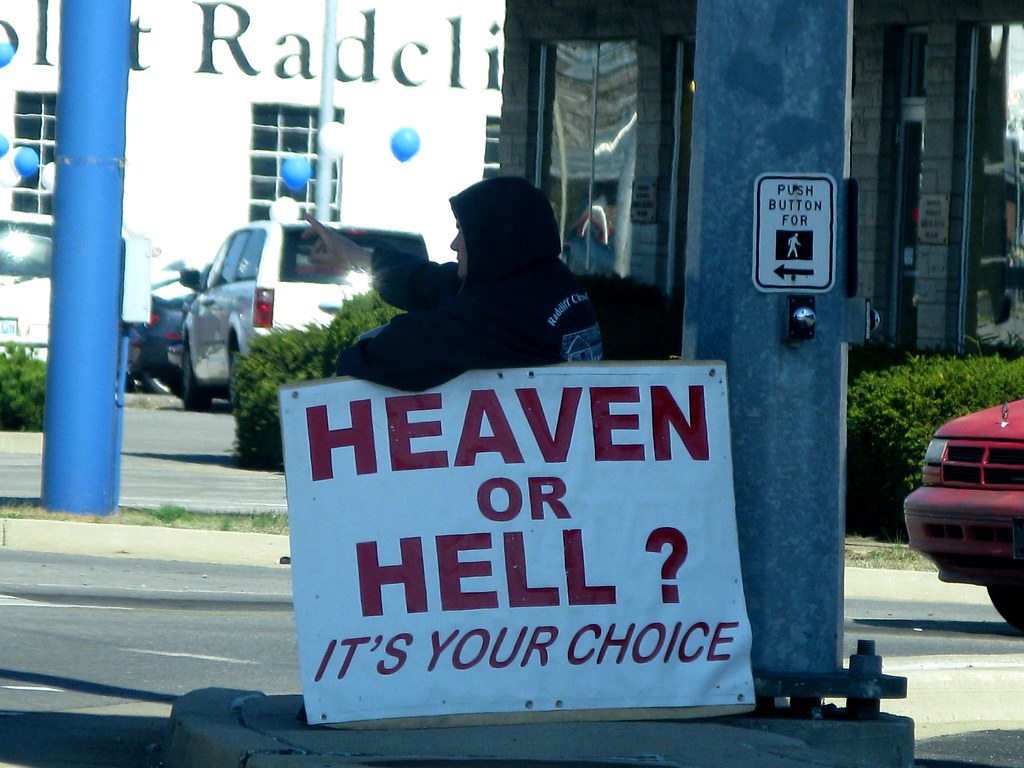
A Street Preacher (though not the one in this case) | by frankieleon, flickr. Used subject to reuse label.

The concrete pathways at the corner of University Boulevard and Hackberry Lane in Tuscaloosa, Alabama, may look and quack like

sidewalks, but as constitutional matter, the Eleventh Circuit considers them something less: an extension of the University of Alabama campus.  In a recent decision, that circuit concluded the sidewalks were not a “traditional public forum” within which the Constitution confines government control of speech and other demonstrations, but rather a “limited public forum” to which the University of Alabama could constitutionally control access. The practical result?  The unlicensed street preacher who sued ‘Bama won’t get a preliminary injunction against the university’s grounds-use policy.

The plaintiff preacher,
Continue Reading Can University of Alabama control preacher’s access to campus sidewalks? 11th Circuit: Roll Tide.

[The following case centered on an ethnic slur and this post therefore includes two references to that slur.]

Reaffirming the First Amendment’s virtual prohibition on viewpoint discrimination, the Second Circuit recently held that New York state could not prohibit a vendor from participating in public lunch program simply because its name and menu featured ethnic slurs.

The case emerged from a dispute over access to the publicly owned Empire State Plaza in Albany, New York.  After years of contracting with a single vendor to supply food for a daily lunch program hosted in the plaza, New York’s Office of General Services (OGS) chose instead to feature a rotating line-up of food trucks—similar to Civic Center Eats program in Denver’s Civic Center Park—subject to a permitting regime.  Plaintiff Wandering Dago, Inc. (“WD”), which operates a food truck with the same name, applied to OGS for a vending permit.  Though the application proceeded normally at first, when OGS officials realized the term
Continue Reading Offensive Name Not a Constitutional Reason to Ban Food Truck from Public Lunch Programs, Says Second Circuit

Earlier this month, the Sixth Circuit vacated a preliminary injunction preventing Lexington-Fayette Urban County Government (the “City”) from enforcing Ordinance 25/2017 (the “Ordinance”), which would regulate where unsolicited written materials may be delivered. Here is what you need to know about the procedural posture of the case:  The Ordinance would allow delivery of unsolicited written materials in six specific locations around a person’s residence or business but would prohibit driveway delivery.  Plaintiff, Lexington H-L Services, Inc., d/b/a Lexington Herald-Leader, delivers The Community News free of charge to more than 100,000 households per week via driveway delivery.  In their motion for a preliminary injunction, Plaintiff claimed that the Ordinance would make their publication financially unfeasible and that it would violate the First Amendment if allowed to go into effect.  The lower court, after applying strict scrutiny analysis to the Ordinance, granted Plaintiff’s request for a preliminary injunction, finding Plaintiff was likely to succeed on the merits of its First Amendment claim.  The City timely appealed to the Sixth Circuit.
Continue Reading Prohibition on Driveway Delivery of Unsolicited Materials Survives Intermediate Scrutiny of Sixth Circuit

Last week, the Tenth Circuit vacated a preliminary injunction preventing Denver International Airport from enforcing much of its public protest policy.  We reported on that injunction after it issued and now return to discuss its reversal on appeal.  In short, the unanimous appellate panel concluded that the airport could reasonably require a seven-day permitting period for protests, even if that requirement quashed most spontaneous demonstrations.

Denver International Airport’s Jeppesen Terminal

A bit of background, though, before we get any further: after the Trump administration unveiled its so-called “Muslim Ban”  (more formally, but less memorably, titled Executive Order 13769) suspending nationals from several predominantly Muslim countries from entering the United States, spontaneous protests broke out in airports nationwide.  Plaintiffs in this case joined in those protests at DIA, where
Continue Reading Tenth Circuit: No Constitutional Need for Speedier Protest Permitting at Denver International Airport

Michael Fowler, a resident of Ventura County, California, cultivated a garden on a portion of his agriculturally-zoned 40 acre property and began renting it out for wedding ceremonies and similar events with much success. However, due to changes to the County’s permit requirements, Mr. Fowler is now required to obtain a conditional use permit (CUP) before hosting any additional weddings on his estate.  With reservations already on his books, Mr. Fowler submitted the required application.  Officials tasked with reviewing his application found that the use would cause no adverse impacts and recommended granting the permit; however, after receiving complaints from neighbors, these same officials denied his application.  The Board of Supervisors upheld the denial on appeal.  This seemingly capricious denial forced Mr. Fowler to chose between breaking the law and dashing the dreams of couples who had already booked his venue by essentially cancelling their weddings.  Sensibly, he chose the latter “option,” resulting in at least one scathing review of his business and untold reputational harm.

Thwarted but not defeated,
Continue Reading Ninth Circuit Rules Against Ventura County Conditional Use Permitting Scheme

Credit: Brad. K, Flickr. Image used subject to creative commons license.

Earlier this year, we reported on a Ninth Circuit decision upholding the City of Oakland’s permitting scheme for donation and collection boxes as a content-neutral, and permissible, exercise of government authority.  Now, however, the plaintiff in that case has asked the Supreme Court to review a narrow question from the Ninth Circuit’s decision: “Is a regulation content based for purposes of the First Amendment where it applies only to unattended receptacles that solicit donations or collections?”

Though we’ve covered this case twice before, as a refresher, Petitioner nonprofit Recycle for Change places donation and collection boxes around Oakland to solicit donated materials for the dual purpose of conserving environmental resources and raising funds for charity.   In 2016, the city enacted an ordinance regulating unattended donation and collection boxes and requiring that property owners or donation box operators obtain a permit, produce a site plan, and carry at least $1 million in liability insurance.  The license fee established under the permitting scheme is $246 per year, and the initial application fee for the permit is $535.  The city’s regulations require maintenance of the boxes, place restrictions on the size and location of the boxes, and prohibit the placement of boxes within 1,000 feet of one another.

Recycle for Change sued Oakland on
Continue Reading Bay Area Nonprofit Asks Supreme Court to Weigh in on Oakland Bin Ordinance

Photo Credit: bootbearwdc, flickr

In this most recent installment of the long-running (and long-vexing) series, “Crèches, Crosses and the Constitution,” a Fourth Circuit majority held that a 40-foot-tall Latin cross situated in the middle of a public intersection, and pictured at right, ran afoul of the First Amendment’s Establishment Clause.  Erected in 1925, the cross memorialized forty-nine soldiers from Prince George’s County, Maryland, near Washington, D.C., who died in World War I.  After standing for the better part of a century, it drew the ire of several area residents and the American Humanist Association, all of whom believed such a prominent display, located on public property and maintained with public dollars, unconstitutionally advanced Christianity.  The district court concluded otherwise, granting summary judgment in favor of the government, and this appeal to the Fourth Circuit followed.

A 2-1 majority
Continue Reading Fourth Circuit: Peace Cross Unconstitutionally Advanced Religion

Day laborers in Oyster Bay. Source: New York Times.

On Tuesday, the Second Circuit Court of Appeals ruled that the Town of Oyster Bay, New York’s prohibition on motor vehicle solicitation of employment violated the First Amendment.  The appellate court’s ruling affirms an earlier district court ruling that found similarly.  The plaintiffs in the case were two groups that advocate for the interests of day laborers.

Oyster Bay enacted an ordinance in 2009 that read, in relevant part, “It shall be unlawful for any person standing within or adjacent to any public right-of-way within the Town of Oyster Bay to stop or attempt to stop any motor vehicle utilizing said public right-of-way for the purpose of soliciting employment of any kind from the occupants of said motor vehicle.”  Oyster Bay’s ordinance was ostensibly an effort to curb day laborer solicitation.
Continue Reading Second Circuit Affirms District Court Injunction Against Oyster Bay Solicitation Ordinance

We are pleased to announce the publication of a new book, Local Government, Land Use, and the First Amendment: Protecting Free Speech and Expression.  The book is published by ABA Publishing, and was edited by the editor of Rocky Mountain Sign Law, Brian Connolly.  Twelve authors contributed to the book, which contains chapters