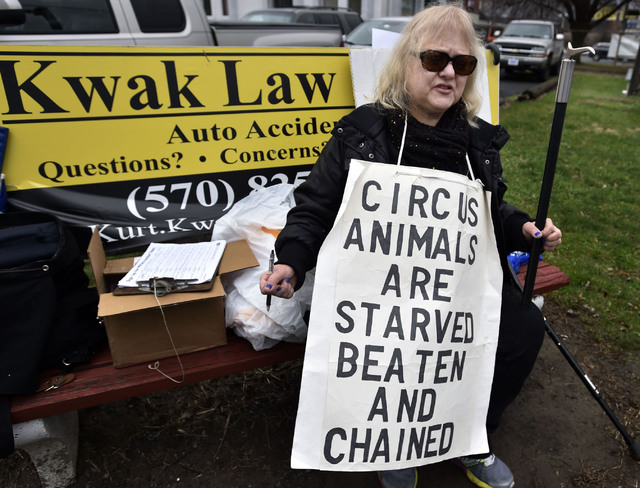
Silvie Pomicter protesting outside Mohegan Sun Arena. Source: The Times Leader.

We previously reported on this case, wherein a group of animal rights activists sought to protest the Barnum and Bailey Circus outside of Mohegan Sun Arena in Wilkes-Barre, Pennsylvania.  In 2016, the district court for the Middle District of Pennsylvania granted a preliminary injunction against the convention center’s protest policy, which required protesters to gather in two areas of approximately 500 to 700 square feet in the arena’s parking lot.  The facts of the case are reported in our earlier blog post.
Continue Reading Animal Rights Activists Win Another Round in Circus Case

James Deferio protesting same-sex marriage in Syracuse. Source: Syracuse University Student Voice.

In a case that we reported on in 2016, a federal district court in New York has granted summary judgment to the plaintiff.  The case involves the regulation of protest speech—specifically, a protester’s activities during an LGBTQ rights parade—on public sidewalks.

A brief recap of the facts is merited.  James Deferio is a Christian evangelist who has protested each year at the Central New York Pride Parade and Festival, held in Syracuse.  Each year, the city issued a permit to the organizers of the parade.  That permit indicated that no speakers would be allowed on sidewalks adjacent to the parade.  At the 2014 event, Syracuse police officers threatened Deferio with arrest in reliance on the permit, and he relocated from the site.  In 2015, the city again approved a permit for the parade, giving the parade exclusive control over First Amendment activities and limiting the use of sound amplification devices near the parade route.  The 2015 permit also allowed for a zone where protest activities could occur.  Deferio again attended the parade to protest.  After minor verbal altercations ensued, a Syracuse police officer told Deferio that he could be arrested for his activities, and he relocated to the zone designated for protest activity.
Continue Reading Summary Judgment Granted to Christian Evangelist in Syracuse Pride Parade Case

Last month, a federal district court in Pennsylvania found that a billboard company’s challenge to the constitutionality of the state’s highway advertising law sufficiently stated a claim for relief and could proceed to further stages of litigation.

Pennsylvania’s highway advertising law contains a general prohibition on sign structures within 500 feet of a highway interchange

A copy of one of the advertisements that the Archdiocese of Washington intended to place on WMATA buses. Source: Archdiocese of Washington.

The Catholic Church’s efforts to “Keep Christ in Christmas” have been stymied by a District of Columbia judge this holiday season.  Earlier this month, the federal district court in Washington rejected a request by the Archdiocese of Washington to enjoin the Washington Metropolitan Transit Authority’s enforcement of its transit advertising policy.  The Archdiocese wished to display, during the holiday season, an advertisement on WMATA transit vehicles that contained the language “Find the Perfect Gift” and a religious image.  The advertisement was intended to encourage readers to remember the religious underpinnings of Christmas.  WMATA rejected the advertisement because it violated the authority’s rule prohibiting advertising that advocates or opposes religion.
Continue Reading Reason for the Season? D.C. Court Upholds Transit Authority’s Rejection of Religious Holiday Advertising

Seabrook Nuclear Power Plant. Source: Northeastern University.

A local nuclear power activist, who expresses concern about the possibility of a nuclear meltdown at a Massachusetts nuclear power, watched his First Amendment claims against the Town of Rowley “melt down” late month.  A federal district court in Massachusetts entered judgment on the pleadings in favor of the town, finding it did not engage in viewpoint discrimination, retaliation, or selective enforcement.

Stephen Comley, a town resident, posted signs in public right-of-ways throughout the town pertaining to his concerns about safety at the Seabrook Power Plant.  In 2015, Comley appeared before the town’s governing body to demand that the town take action against the power plant.  Following Comley’s appearance before the town board, he noticed that his signs began disappearing from the public right-of-ways, which reportedly hosted several other signs relating to elections and other subjects.  He then brought First Amendment claims for viewpoint discrimination, retaliation, and selective enforcement.
Continue Reading Massachusetts Town Prevails in Nuclear Power Protest Case

Protesters near Planned Parenthood in Pittsburgh. Source: CBS Pittsburgh.

Last week, a federal district court granted summary judgment to the City of Pittsburgh, Pennsylvania in a long-running dispute over a buffer zone law applicable to protest activities outside of reproductive health facilities such as Planned Parenthood.  The court held that the city’s 15-foot buffer zone law was content neutral and narrowly tailored to a substantial governmental interest, and thus valid under the First Amendment.

Pittsburgh enacted its buffer zone law in 2005.  The initial buffer zone law initially imposed a 15-foot buffer zone around the entrance to a hospital or health care facility in which no person was permitted to congregate, patrol, picket, or demonstrate.  The buffer zone excepted public safety officers, emergency workers, employees or agents of the facility, and patients.  The law also imposed an eight-foot “personal” buffer zone around individuals.  In the eight-foot buffer zone, no person could approach an individual to provide a leaflet or to protest, where the individual was within 100 feet of a hospital or health care facility entrance.  The eight-foot personal buffer zone was struck down in the case of Brown v. City of Pittsburgh in 2009.  The 15-foot buffer zone remained in effect, but was challenged again in 2014 following the Supreme Court’s decision in McCullen v. Coakley, in which the Court struck down a Massachusetts law imposing a 35-foot buffer zone around health care clinics.  The plaintiffs in the case are religiously-motivated protesters who engage in protest activities around a Planned Parenthood facility in Pittsburgh.  In 2016, as we reported, the Third Circuit reversed the district court’s dismissal of the case.
Continue Reading District Court Finds in Favor of Pittsburgh Buffer Zone Law

Webcast— Special Topics in Planning and the First Amendment: Signs, Adult Businesses, Religious Land Uses, and More

December 14, 2017

1:00 p.m. – 2:30 p.m. EDT

CM | 1.50 | Law

CLE 1.50 through Illinois State Bar

The Planning and Law Division of the American Planning Association is pleased to host the upcoming webcast Special

Last week, a federal district court in Nevada ruled on the City of Reno’s motion to dismiss several claims brought against it by a billboard company and landowner relating to the placement of off-premises billboards in the city.

The plaintiffs in the case are a billboard company called Strict Scrutiny Media (which perhaps implies the type of judicial review that the company wanted, but did not get, in this case) and the Independent Order of Odd Fellows Reno Lodge #14.  SSM obtained billboard leases at three sites owned by the Oddfellows, constructed signs on all three locations, and obtained permits for the construction of one of the signs.  In late 2016, the city informed SSM and Oddfellows that the permitted sign’s permit was invalid due to the fact that it was issued to a different sign operator, and also informed Oddfellows that two other signs that had been installed by SSM and Oddfellows were constructed without a permit in violation of the city’s code.  Oddfellows and SSM then challenged the city’s action, and also challenged the city’s ban on the erection of new, permanent off-premises signs and the city’s exemptions to permit requirements for certain temporary or permanent on-premises signs.
Continue Reading Court Allows First Amendment Claims to Move Forward in Reno Sign Code Case

Last week, the Ninth Circuit Court of Appeals upheld San Francisco’s prohibition on new off-site commercial billboards, rejecting a First Amendment claim to the contrary made by a billboard company.  The case reaffirms the distinction between commercial and noncommercial speech regulation under the First Amendment, and limits the scope of Reed v. Town of Gilbert.

Since 2002, San Francisco has prohibited the erection of new off-site billboards—which advertise products or services not available on the property where the billboards are located—while allowing new on-site business signs.  The prohibition amounts to an effective ban on new billboards in San Francisco, although billboards that predated the ban are allowed to remain in place.  The plaintiff, Contest Promotions, LLC, is a billboard company that challenged San Francisco’s regulation under the First Amendment.  The district court for the Northern District of California granted a motion to dismiss filed by the City and County of San Francisco.
Continue Reading Ninth Circuit Allows San Francisco’s Billboard Ban to Stand

Nashville Pride Festival. Source: Nashville Pride.

Late last month, a federal district court in Tennessee granted summary judgment to the Nashville metropolitan government in a case involving the rights of protesters at the 2015 Nashville Pride Festival, which is a celebration of LGBTQ rights and culture.

Nashville Pride Festival is held in the City’s Public Square Park.  In order to hold the festival in the park, Nashville required the organization Nashville Pride to obtain a permit.  The event was ticketed, such that only those with tickets could enter into the park.  The plaintiffs in the case, John McGlone and Jeremy Peters, believe that homosexuality is a sin.  They attended the festival in protest, but stayed outside the ticketed area.  A festival employee asked them to leave the area outside of the gate, as it was subject to Nashville Pride’s permit.  Eventually, the protesters were removed to a location on the other side of the street from the park.  This location was unsatisfactory to the plaintiffs, because they believed that their message would reach less people.
Continue Reading Court Upholds Relocation of Protesters at Nashville Pride Festival